Mapping the infinite coordinates of inquiry.
The graph maps the question space — linking taxonomy, routing lenses, and source strategies to the literature and tools that ground them.
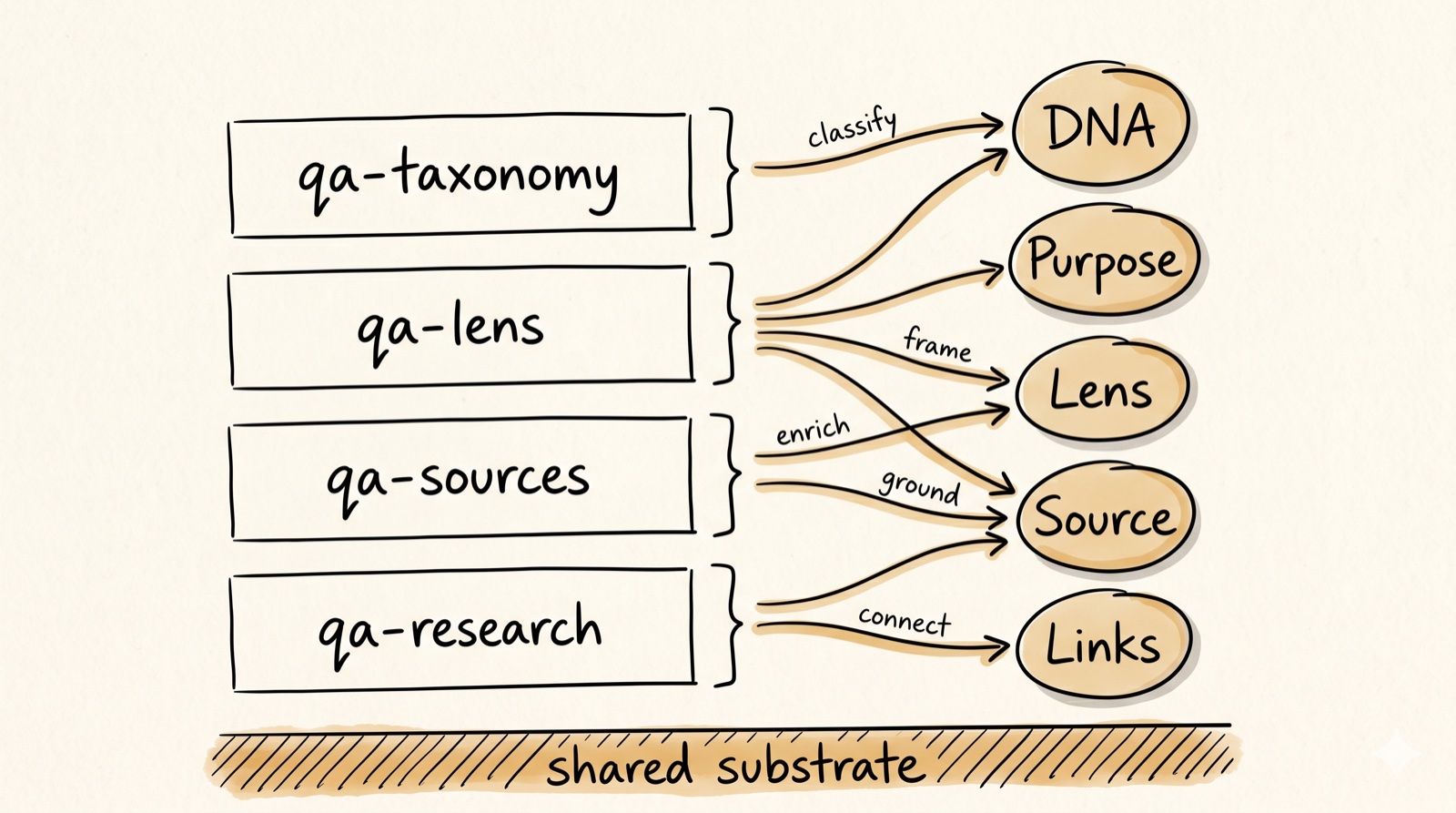
Fig. 1 — four layers, five guiding questions, one shared substrate
The DNA & Purpose
Establishes the structural coordinate system of the question space. Deterministic and LLM-judge evaluators check whether a generated question meets its taxonomic constraints — testing reasoning, not just recall.
The Routing Lens
Routes messy user goals to specific generation strategies. It reads the target goal and source context to choose the right lens — an adaptive interview for discovery, a direct pipeline for assessment.
Source Conditioning
Pre-processes source documents to guarantee factual grounding. It categorizes the source shape and recommends an enrichment strategy — chunk maps, clause hierarchies, or semantic graphs — matched to the target taxonomy.
Scientific Provenance
The verifiable academic backbone. Every concept links back to its papers and research claims, and the provider registry maps third-party SDK capabilities directly to the strategies they can execute.
The graph is the shared cognitive substrate for the entire ecosystem.