In an era of infinite answers, the right question is your greatest asset.
"Wisdom begins in wonder." Socrates
Generative AI produces infinite answers. qa-tools focuses on something far more valuable: the ability to ask the right questions—the questions that reveal gaps, verify understanding, and uncover deeper insight.
Mastering Question Lifecycle
Design, run, and analyze questions like a governed dataset—inside reproducible experiments.
Design
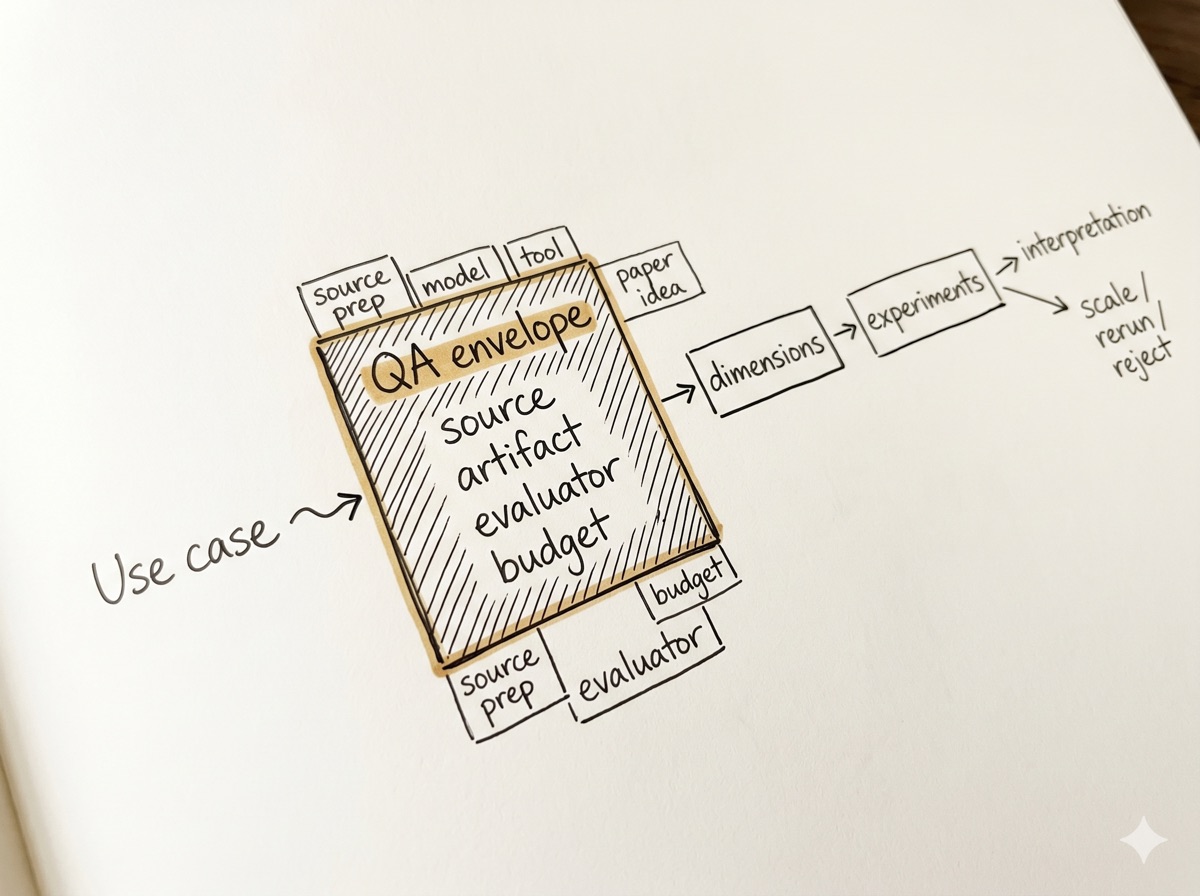
Define the use case, constraints, and success signals. Smoke-test plans before you generate.
Run
Generate → evaluate → dedup → filter. Iterate with measurable optimization loops.
Analytics
Cluster and compare runs. Reveal gaps, redundancy, and benchmark progress.
Use Cases
From evaluation pipelines to knowledge extraction, qa-tools adapts to your domain
Public Dataset Profiling
Infer governed taxonomies for QA datasets. Turn flat question–answer pairs into auditable, queryable artifacts for coverage, difficulty, and reasoning analysis.
Controlled Dataset Expansion
Expand QA datasets through an evaluated loop that balances correctness, novelty, and drift.
Ontology Inference
Identify which relations a QA dataset tests — and which parts of the domain are missing entirely.
Compare AWS Exams
Compare topic coverage, difficulty distribution, and semantic redundancy across providers with reproducible analytics—not just accuracy.
RAG QA Cache and FAQ
Use a curated QA layer as a reliability cache for RAG. Answer known questions deterministically, reduce cost and latency, and fall back to retrieval when needed.
RAG Decomposition
Decompose complex questions into explicit sub-questions. Make each reasoning step evaluatable, traceable, and improvable with question trees.
How to use it
Choose your interface—keep the same lake + experiment semantics.
CLI
Run experiments from the terminal or Agent coder
Notebook
Explore and iterate in notebooks
Interop
Design in qa-tools. Execute in Haystack, Distilabel, LangGraph.
Is qa-tools a commercial product today?
Not yet. qa-tools is available via PoC and research collaborations. We are intentionally validating the system with real projects before offering a standard product.
What is the main difference between qa-tools and other question-generation systems?
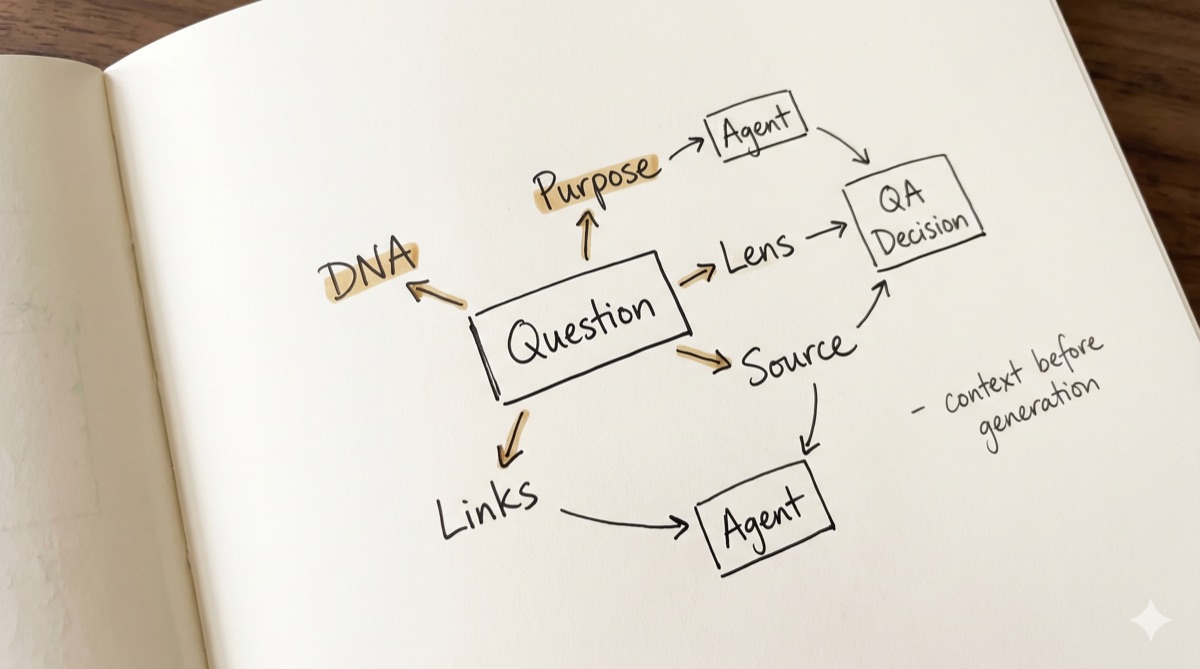
Most systems optimize for generating many plausible questions. qa-tools optimizes for answering three higher-order questions: why two questions are different, why one question is better than another for a given purpose, and what question should come next.
These questions cannot be answered reliably without explicit structure. Taxonomy is what turns question generation from a creative act into a governable system.
Why is it so hard to generate meaningful questions with generative AI?
Modern AI systems are optimized to answer questions, not to decide which questions are worth asking.
Most public datasets, synthetic data tools, and evaluation frameworks are answer-centric. They reward correctness, fluency, or similarity to a reference answer. Questions are treated as temporary prompts rather than durable assets.
Meaningful question generation requires encoding intent, comparing questions against each other, and understanding progression. Without structure, questions cannot be ranked, improved, or governed—only generated.
Isn't qa-tools complex if it supports so many use cases? Do I need to become a configuration expert?
No. Complexity is handled by the compiler, not the user.
qa-tools uses a spec-driven approach inspired by systems like GitHub SpecKit. Users describe intent in plain language, and the system translates it into machine-readable instructions.
You do not configure the engine; you declare what you want to test and why.
What is an evaluator in qa-tools?
An evaluator in qa-tools is a formal rule or model that scores the quality of a question, not just the correctness of an answer.
Evaluators may assess the question alone, the question-answer pair, or the question in context. Built-in evaluators enforce the taxonomy contract of an experiment, ensuring generated questions respect the intended structure.