Controlled Dataset Expansion
Expand QA datasets through an evaluated loop that balances correctness, novelty, and drift.
What Is Dataset Expansion?
Dataset Expansion is the process of taking an existing QA dataset and adding new questions that respect the same style, scope, and quality as the original data.
The goal is not to generate arbitrary new questions, but to extend a dataset without changing what it is:
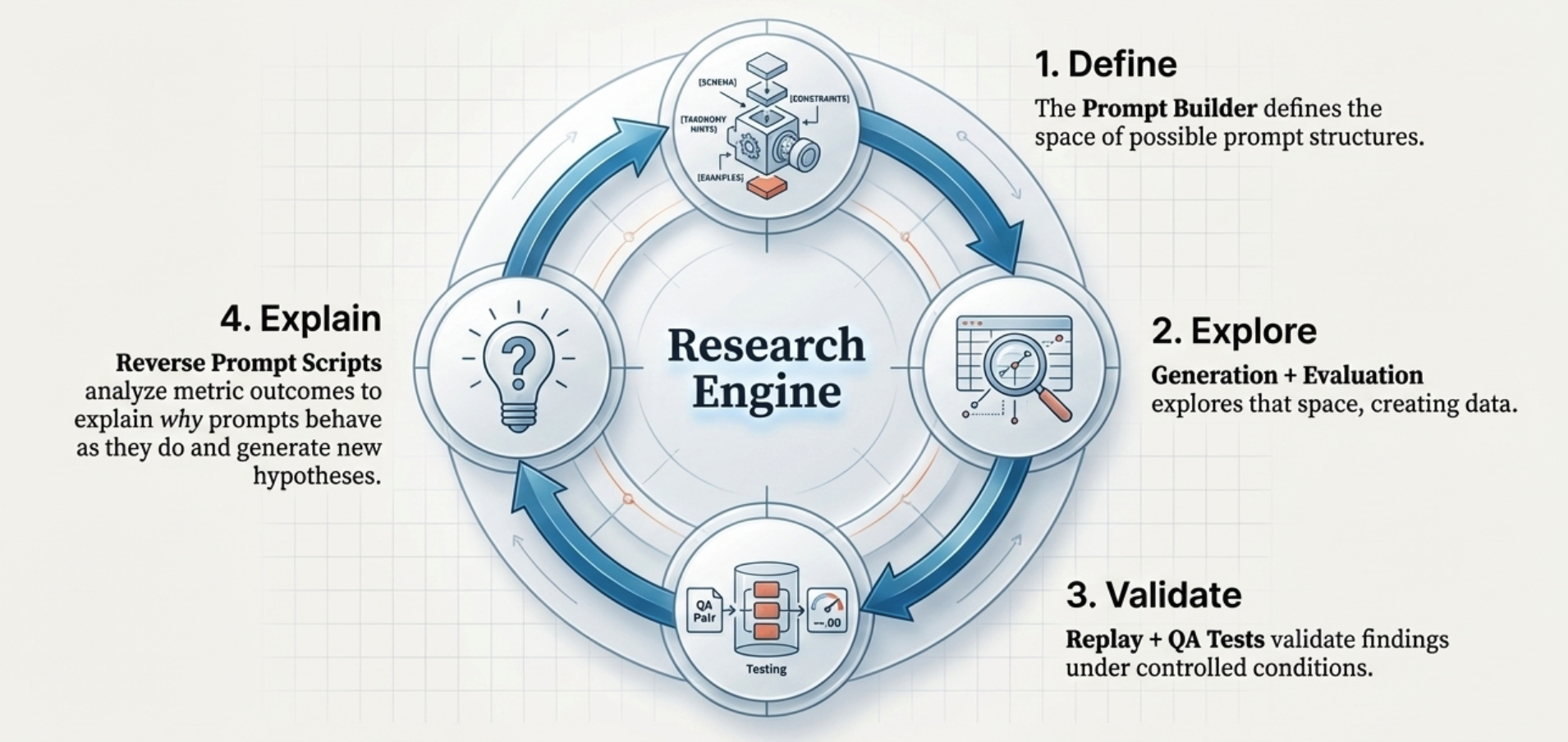
In qa-tools, Dataset Expansion is treated as a controlled, evaluated loop, not a one-shot generation step.
Why It Is Hard
At first glance, expanding a dataset sounds straightforward: "generate more questions like these."
In practice, small changes in prompt wording, scope, or evaluation criteria can quickly lead to significant issues.
Stylistic drift
New questions lose the original voice, tone, or structural complexity.
Topic expansion
The model drifts into unintended, adjacent, or irrelevant subject areas.
Duplication
Generating templated, repetitive, or semantically identical questions.
Quality regression
Subtle drops in answer accuracy, reasoning chains, or factual grounding.
For this reason, Dataset Expansion is not solved. This use case documents where it works today, where it breaks, and how qa-tools makes those limits visible.
How It Works
A closed, measurable loop — not one-shot generation.
When Expansion Works Best
Stable style
Consistent question form, tone, and answer format.
Clear topical scope
Domain vocabulary is consistent throughout.
Well-specified task
Short factual QA, definitions, API usage, etc.
Reliable judgment
Candidates can be evaluated using similarity and quality rubrics.
Enough semantic signal
Not ultra-short, not ambiguous content.
Common Failure Modes
Missing context
No grounding information for generated questions.
Ambiguity
Questions with multiple valid interpretations.
Over-broad scope
Topic expands → drift into unintended areas.
Template collapse
Low diversity in generated outputs.
Wrong thresholds
Evaluation criteria don't reflect task reality.
These are signals, not bugs.
What We Measure
Instead of claiming success, qa-tools measures behavior. For each dataset, we report:
Expansion is considered "healthy" when acceptance stabilizes without collapsing diversity.
Not all datasets are equally expandable
If expansion fails, the loop shows why — through low acceptance, drift, or novelty collapse. This is a governance signal, not a failure.